“When
I came back from Vietnam I was 21,” said the silver-haired
information technology manager in the dark suit with discrete rows of military
service citations. But no warm welcome awaited him and his fellow Vietnam War
veterans, particularly from their college student peers. “They were cruel
to us,” he recalled recently for a mostly alumni audience in UCSB’s
Hatlen Theatre.”
“They verbally stoned us,” Jim Nolan said quietly, without reproach. “They
wouldn’t allow us to be part of our own generation; they shunned us.”
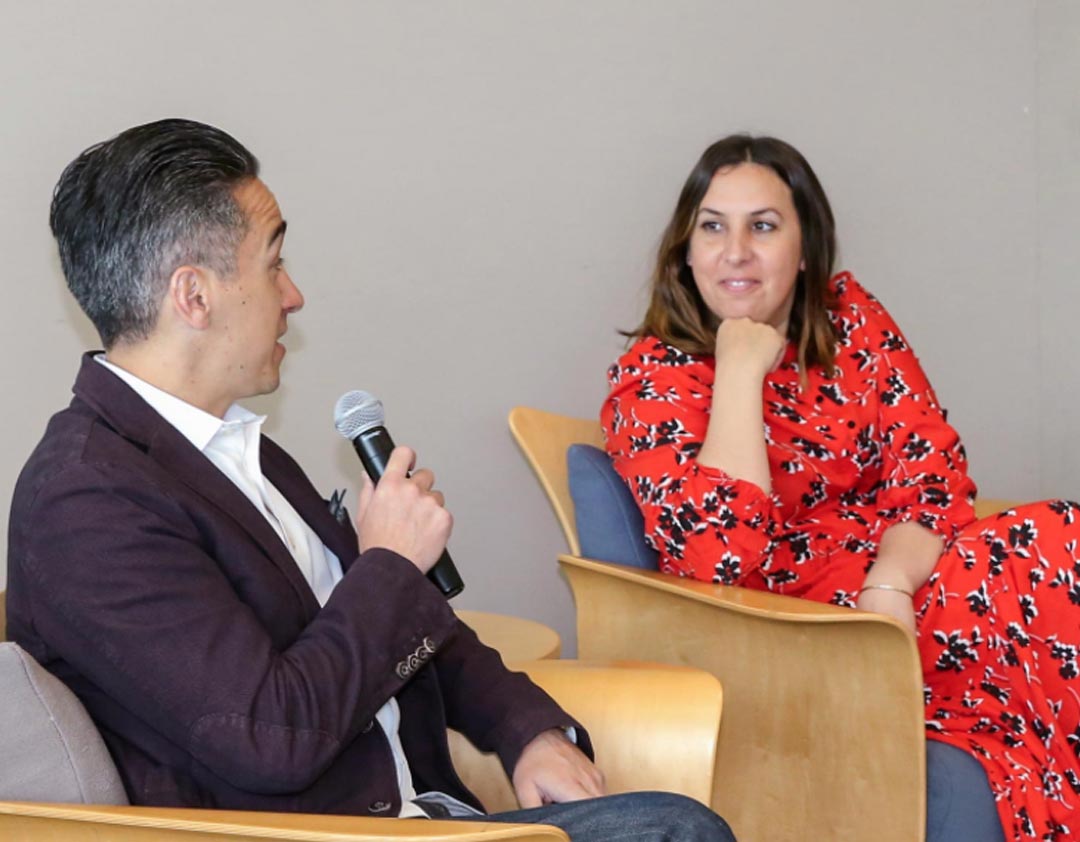
Nolan spoke at a podium during the All Gaucho Reunion as one of four panel
members examining the theme of “Coming Home” with former students
from the university’s Religious Studies 155 class, “The Impact of
the Vietnam War on American Religion and Culture.” For the past seven years
the ex-Marine has been a presenter for this course, the first of its kind in
the nation when the late Professor Walter Capps launched it in 1979.
Wilson Hubble, another panelist, has been a presenter since 1984—the
course is offered once a year in the winter quarter—and he recruited Nolan
for RS 155. Hubble, who is also a decorated combat veteran, was a helicopter
crewman in Nam and, he told the audience, he was initially suspicious of this
civilian academic who wanted veterans to tell students their personal stories.
Capps gained his trust by telling Hubble and other vets that he and his students
wanted to learn from them. Despite stage fright and concerns about being judged,
the veterans told the audiences that packed Campbell Hall what they had done
in the war and what the war had done to them. At the end of each veteran’s
presentation, no matter how graphic or laced with profanity, mild-mannered Walter
Capps led the students in saying, “Welcome home.”
Hubble said that many vets bore spiritual scars even if they showed no physical
wounds, and it was difficult to recount their experiences. He told the Hatlen
audience that at first his own story was “a disjointed series of memories,
some of which I was trying to suppress.” It became a coherent plea for
understanding.
“These were not just war stories,” he said. “The class was
an instrument of healing and new beginnings.” So much so that Hubble, who
is an environmental planner for the County of Santa Barbara, has never been able
to tell his parents or his brother about the experiences he regularly shares
with RS 155 students.
Nolan, now 62, affirmed the healing qualities of the course: “When you’re
asked to become someone capable of taking another’s life, it changes you.
A little bit of you dies, too; it takes your humanness from you.” In a
soft, constricted voice that struggled for control, he continued, “We needed
that back; we needed forgiveness, and that’s what the class provides.”
Panelist Jim Quay, who was a conscientious objector (CO) during the Vietnam
War, observed that not only soldiers hungered for confession and forgiveness. “Our
country sent the soldiers to war,” he observed. “They fought in our
name, so we, too, needed forgiveness.”
Quay and Walter Capps worked together in the 1980s when Quay headed the California
Council for the Humanities. RS 155 had yet to hear from a CO, so Quay was invited
to speak to the class. On the day he spoke, a crew from CBS Television’s “60
Minutes” was filming for a report on the class, one of two that the newsmagazine
would broadcast over the years.
After he ended his comments, a vet in the class called out, “Welcome
home.” Due to the TV lights, Quay could not see the speaker but later he
learned his name. “I was hoping Denver Mills would be here today,” he
told the alums. “It was an extremely generous welcome, and I appreciated
it.”
If presenters were changed by the Vietnam War course, so in their individual
ways were the students, Capps’ colleagues, and Capps himself. The vets
have made the class what it is, noted panelist Representative Lois Capps, Walter’s
widow. “They were its most natural and powerful teachers,” she said,
adding that Walter felt that, too. “You (vets) touched him profoundly,
and reordered his thinking, and priorities.”
After teaching the class for 16 years, Capps passed the baton in 1995 to religious
studies colleague Richard Hecht and, though he failed his first attempt, Capps
won the 22nd Congressional District seat in Congress. Unfortunately, a heart
attack felled him a little more than 10 months into his term.
Lois was elected his successor. Ten years since his death, after being re-elected
five times, she no longer stands in Walter’s shadow, if ever she did. However,
but for RS 155 her life would likely have been much different.
She told the audience, “I believe this course, which you all developed
together, was a major part of what led Walter to run for public office.” Personally,
she added, her “legacy from this class” and what she learned from
the soldiers was on display in 2002 when she was one of 133 members of the House
of Representatives to vote against a joint resolution authorizing war against
Iraq. “I had no other choice,” she said.
Hecht, who originally thought his role would be temporary, has continued the
evolution of RS 155 for the past 13 years. He summed up many students’ reaction
to the class as “life-changing,” and some of the alumni gathered
in Hatlen testified to feeling that way, even years later.
With warfare continuing in Iraq and Afghanistan, over the last three years
Hecht has integrated vets from those battlefields into the course, drawing parallels
to Vietnam when appropriate. As he wrote in the current class syllabus: “War
itself…remains a challenging component (to RS 155). In this course, past,
present and future merge for all of us.” Hecht hopes to stage an alumni
reunion next year on the course’s 30th anniversary.
|